I agree with Jillian- this book had wonderfully beautiful scenes and description. I was blown away by the emotional beauty of it all too. Given I define beauty as a sort of intensity and thought provoking emotion, rather than just the prettiness of it all. The contrast in the dingy and the pure of society, as well as the grey area in between was just shocking at times.
Often I found I could identify with Bakha, when he turned his face into the sun and breathed in the untainted air. I knew what it was like to be confused about ones place when the signs all around pointed in many directions. I'd have to say that of all of the novels/books we read throughout the class- through description and detail Anand's was the best (though the story in L. Woolf's novel was my favorite). I know I'm repeating myself, but wow- the contrast and the depth in this was amazing.
Thursday, July 23, 2009

Finding the Poet
"As the brief Indian twilight came and went, a sudden impulse shot through the transformations of space and time, and gathered all the elements that were dispersed in the stream of his soul into a tentative decision: 'I shall go and tell father all that Gandhi said about us,' he whispered to himself, 'and all that that poet said. Perhaps I can find the poet some day and ask him about his machine.' And he proceeded homewards" (Andand 157).
Wow! What a great ending. Anand paints for us a beautiful portrait of natural beauty, realization, and potential that leaves the reader fulfilled and hopeful, even at the end of a novel whose main character constantly wades through filth. Bakha's journey has only begun, and his destiny seems to be framed by Gandhi, the poet, and the toilet (you can substitute technology for toilet if it makes you more comfortable). Anand tells us in Conversations in Bloomsbury that "consciousness is about something other than itself, awareness of an object. Thus one is because of others" (132). Bakha's identity--his status as social outcast, his noble personality, and his egotistical naivete--are dependent upon culture and perception. Freedom from these things is impossible. Anand realizes that the best we can do is construct for ourselves an identity that we are proud of, much like Bakha does. Is Bakha perfect? No. But neither am I...neither is anyone. But, for better or worse, I am who I am because of my culture. Bakha is not like the other characters we've read this semester; he exists because of his culture, not in spite of it. And Anand seems to be okay with that.
Wow! What a great ending. Anand paints for us a beautiful portrait of natural beauty, realization, and potential that leaves the reader fulfilled and hopeful, even at the end of a novel whose main character constantly wades through filth. Bakha's journey has only begun, and his destiny seems to be framed by Gandhi, the poet, and the toilet (you can substitute technology for toilet if it makes you more comfortable). Anand tells us in Conversations in Bloomsbury that "consciousness is about something other than itself, awareness of an object. Thus one is because of others" (132). Bakha's identity--his status as social outcast, his noble personality, and his egotistical naivete--are dependent upon culture and perception. Freedom from these things is impossible. Anand realizes that the best we can do is construct for ourselves an identity that we are proud of, much like Bakha does. Is Bakha perfect? No. But neither am I...neither is anyone. But, for better or worse, I am who I am because of my culture. Bakha is not like the other characters we've read this semester; he exists because of his culture, not in spite of it. And Anand seems to be okay with that.
Response to Ruth's Response
I too rather enjoyed both sections from the Conversations in Bloomsbury packets as well as the Berman piece. I especially appreciated the budding (if not fully formed) intimacy and mutual appreciation evident between Anand and his Western contemporaries. What becomes evident in the reading is Anand's place in a dynamic, ever-evolving culture of ideas which, coupled with his knowledge of Indian culture and myth constructs his unique brand of regional cosmopolitanism. Anand's time in England allowed him to observe social customs abroad which both coincided with and diverged from those of his homeland. Modernist thought became especially paramount in informing (and in some senses determining) his aesthetic choices, all while leaving his concern with India's socio-political climate definitively in tact.
As Berman states, dalit literature, "demonstrates the importance of conceiving modernism as a mode of writing that arises in many forms, guises, and locations in response to the social, political, and aesthetic developments of modernity. Writers in the colonies not only responded to local traditions and the writing they knew from abroad but also developed their own forms and modes, which in turn contributed to literary development both at home and abroad." Anand seemed fixed in these crosscurents, all the while focalizing India within this Modernist maelstrom. To again quote Berman, "Modernism does not move in one direction from Europe to the colonies, or even from the colonies straight back to Europe, but rather must be seen as part of a multidirectional flow of global literature and culture, with streams of discourse that also move around within a country and, as in the connection between Joyce and Anand, even from colony to metropolis to another colony and back again." In short, Anand's work seems to remain equally independent and inseparable from Western influence-a necessarily Modernist anomaly.
As Berman states, dalit literature, "demonstrates the importance of conceiving modernism as a mode of writing that arises in many forms, guises, and locations in response to the social, political, and aesthetic developments of modernity. Writers in the colonies not only responded to local traditions and the writing they knew from abroad but also developed their own forms and modes, which in turn contributed to literary development both at home and abroad." Anand seemed fixed in these crosscurents, all the while focalizing India within this Modernist maelstrom. To again quote Berman, "Modernism does not move in one direction from Europe to the colonies, or even from the colonies straight back to Europe, but rather must be seen as part of a multidirectional flow of global literature and culture, with streams of discourse that also move around within a country and, as in the connection between Joyce and Anand, even from colony to metropolis to another colony and back again." In short, Anand's work seems to remain equally independent and inseparable from Western influence-a necessarily Modernist anomaly.
Anand's Use of Nature
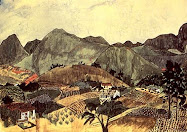
One thing that I found particularly interesting when reading Untouchable was the beautifully scripted passages conveying the scene of the Indian countryside. In many of the scenes involving nature, Bakha is looking out over the open space and seems to be contemplating what it would mean to experience the freedom that nature allows. It is almost as if Bakha is looking for a way to define himself other than what his culture has provide for him. Almost to say that the only place where he can truly be himself is to seperate himself from the city he lives in and re-join nature.
This definitely adheres to the idea that Modernist texts are going 'back to nature'. It also provides somewhat of a Romantic idea about the unspoiled nature versus the tainted image of the urban area. It is also interesting to note that the positive things that do happen to Bakha over the course of this particular day, happen away from the city. For instance, the bliss that he feels while walking outside the city with his new hockey stick and when he witnesses Ghandi's speech. It as if life holds greater possiblity for him when he escapes the city; that by leaving the city he is also leaving religion and the caste system behind with the hope of starting a new life.
This definitely adheres to the idea that Modernist texts are going 'back to nature'. It also provides somewhat of a Romantic idea about the unspoiled nature versus the tainted image of the urban area. It is also interesting to note that the positive things that do happen to Bakha over the course of this particular day, happen away from the city. For instance, the bliss that he feels while walking outside the city with his new hockey stick and when he witnesses Ghandi's speech. It as if life holds greater possiblity for him when he escapes the city; that by leaving the city he is also leaving religion and the caste system behind with the hope of starting a new life.
Response to Taryn (with grin on face)
Taryn, I energetically signed in all ready to continue my rhapsodic responses to Anand in these 'conversations' and lo and behold--there was your piece! I chuckled out loud in the library--not at WHAT you said, but at your vehemence (which I always feel myself--and yes, with that dose of guilt for feeling "unprofessional.") This is what I love about art and literature--we get to be subjective and educated at the same time, and realize that neither of our responses is more correct than the other--yet they are so delightfully opposite! So... to what I was going to add to my post from Tuesday (which precedes yours in this blog.)
I mentioned how much I enjoyed reading "Under the Chestnut Tree" AFTER reading "Untouchable" because it allowed me to hear/feel/understand Anand better having gotten a clue to what made him tick from his creative work. Well, after Michael's presentation Tuesday night and after reading "Toward a Regional Cosmopolitanism" today, I feel an even greater ability to understand Anand and relate to him on a personal level.
Something that I noticed with a touch of endearment, was the way that Anand, Forster, and Woolf tentatively circle each other in conversation like three people who are testing ground and recording data before committing verbally. Forster gives mild reproof re modes of address, Anand notices that Forster's answer was liberally sprinkled with "Hindustani words, obviously from a more intimate knowledge of India that most Britishers displayed,"(72) and later Woolf expresses surprise at Anand's comparison of a Shakespeare character (Caliban) to Gandhi by "looking from the corner of his eye" at Forster and saying, "I never thought of that equation"(78). Rather than being put off by all these minor details pertaining to movement, reactions,expressions, I am suddenly seeing "regional cosmopolitanism" exemplified in all three of these writers.
The first point I valued in "Toward a Regional Cosmopolitanism" was the statement, "The tension between the local and universal inhabits the history of the word 'cosmopolitan. . . ' "(144). I needed to read that, because I know that I bandy that word around a little to liberally. The conversation between these three highly intelligent men--culturally different in so many ways--is heartening if one buys into Appiah's pluralist version of cosmopolitanism, that being "we should learn about people in other places, take an interest in their civilizations, their arguments, their errors, their achievements, not because that will bring us to agreement but because it will help us get used to each other "(qtd in Berman 146). These three men in a garden, jockeying for position, are "getting used to each other" on equal terms. Anand as the "colonized" party does not seem lesser than Woolf and Forster who represent the colonizing party because their literary works earn them equal kudos for attempting to find commonality. Anand's name dropping and English word coinages do not bother me. He has been invited to the table, as it were, and he is talking the talk. Toward the end of Berman's article she upholds Anand in this by saying, "Anand is described as mimicking the language developing around him rather than employing language in an experimental way or using it to force recongnition...of Indian culture. . . .I would argue that reading Anand within the context of his regional cosmopolitanism, and his efforts to 'bridge' 'the Ganga and the Thames' makes clear the inadequacy of describing these quasi-Hindi, quasi-English moments purely in terms of linguistic verisimilitude"(158).
All-in-all, I look forward to discussion tonight!
Ruth
I mentioned how much I enjoyed reading "Under the Chestnut Tree" AFTER reading "Untouchable" because it allowed me to hear/feel/understand Anand better having gotten a clue to what made him tick from his creative work. Well, after Michael's presentation Tuesday night and after reading "Toward a Regional Cosmopolitanism" today, I feel an even greater ability to understand Anand and relate to him on a personal level.
Something that I noticed with a touch of endearment, was the way that Anand, Forster, and Woolf tentatively circle each other in conversation like three people who are testing ground and recording data before committing verbally. Forster gives mild reproof re modes of address, Anand notices that Forster's answer was liberally sprinkled with "Hindustani words, obviously from a more intimate knowledge of India that most Britishers displayed,"(72) and later Woolf expresses surprise at Anand's comparison of a Shakespeare character (Caliban) to Gandhi by "looking from the corner of his eye" at Forster and saying, "I never thought of that equation"(78). Rather than being put off by all these minor details pertaining to movement, reactions,expressions, I am suddenly seeing "regional cosmopolitanism" exemplified in all three of these writers.
The first point I valued in "Toward a Regional Cosmopolitanism" was the statement, "The tension between the local and universal inhabits the history of the word 'cosmopolitan. . . ' "(144). I needed to read that, because I know that I bandy that word around a little to liberally. The conversation between these three highly intelligent men--culturally different in so many ways--is heartening if one buys into Appiah's pluralist version of cosmopolitanism, that being "we should learn about people in other places, take an interest in their civilizations, their arguments, their errors, their achievements, not because that will bring us to agreement but because it will help us get used to each other "(qtd in Berman 146). These three men in a garden, jockeying for position, are "getting used to each other" on equal terms. Anand as the "colonized" party does not seem lesser than Woolf and Forster who represent the colonizing party because their literary works earn them equal kudos for attempting to find commonality. Anand's name dropping and English word coinages do not bother me. He has been invited to the table, as it were, and he is talking the talk. Toward the end of Berman's article she upholds Anand in this by saying, "Anand is described as mimicking the language developing around him rather than employing language in an experimental way or using it to force recongnition...of Indian culture. . . .I would argue that reading Anand within the context of his regional cosmopolitanism, and his efforts to 'bridge' 'the Ganga and the Thames' makes clear the inadequacy of describing these quasi-Hindi, quasi-English moments purely in terms of linguistic verisimilitude"(158).
All-in-all, I look forward to discussion tonight!
Ruth
Issues with Conversations in Bloomsbury
I felt this way as I read the first excerpt of Anand's Conversations in Bloomsbury several weeks ago, and after reading the three excerpts for tonight I have only confirmed my feeling: reading this book is an odd and distracting experience. While it's interesting to be able to read about conversations that Anand had with such famous literary figures, his style at times completely detracts from the flow of the "story." I realize Anand is a subjective narrator by necessity, and I acknowledge that at times his subjectivity grants us an intimate look into the lives of these people we only know through secondary sources. However, what is the import of statements like, "Morrison offered shortbread biscuits" (126)? Some may read this narrative recollection as a quaint and enlightening look through one person's eyes into the community of Bloomsbury, but I find the form Anand has chosen to be irritating and cumbersome. I really don't care to read all of the insignificant details as to who ate and drank what, or what T. S. Eliot's handshake was like. These constant, jarring asides take away from the meat of the story and distract the reader from the heavier issues at hand. I'm interested to see if others felt the same way as they read, or if most of you saw these additions as adding something substantial to the text.
Another thing that grated on my nerves as I read was the obsequious tone Anand adopts, particularly in his conversation with Eliot. It makes sense that he would feel nervous and edgy around the talented poet, but it still made me hate him a little, much as his constant name-dropping did. I realize name-dropping is the whole point of the book, but...I want to say to Anand, "Yeah, we know, you met some really famous people and some of them even liked your book. Good for you. Fabulous. Yay. Now shut up." And now, since I appear to have completely lost any semblance of a professional tone here, I'm going to stop writing.
Another thing that grated on my nerves as I read was the obsequious tone Anand adopts, particularly in his conversation with Eliot. It makes sense that he would feel nervous and edgy around the talented poet, but it still made me hate him a little, much as his constant name-dropping did. I realize name-dropping is the whole point of the book, but...I want to say to Anand, "Yeah, we know, you met some really famous people and some of them even liked your book. Good for you. Fabulous. Yay. Now shut up." And now, since I appear to have completely lost any semblance of a professional tone here, I'm going to stop writing.
Tuesday, July 21, 2009
The Joy of Reading "Under the Chestnut Tree in Tavistock Square AFTER reading "Untouchable"
When we were first given "Under the Chestnut Tree in Tavistock Square" to read, I read it dutifully and, if the truth be told, found little to engage my interest. At that point, I had no clue who Mulk Raj Anand was, was not that acquainted with "Passage to India" nor the stance that Forster took toward India within the novel, and had only Leonard Woolf's rather magnanimous and even-handed voice in "The Village in the Jungle" to aid in understanding the tone of this three-way conversation. Re-reading the essay this week was a joy, for here, reincarnated in that tone, is Bakha from "Untouchable!" I remember mentioning that Leonard Woolf seemed to be very present within certain sections of "The Village in the Jungle." I feel the same way about Anand being present in "Untouchable" (of Hurston being present in "Their Eyes...") I know that in the visual and other artistic genres, modernism relaxed the formal need for withdrawal and objectivity and instead advocated a new sort of subjective immersion where art and artist (and sometimes audience) overlapped and even fused within the artistic process. Is this a trait of modernist literature as well? I find it plausible--even if based upon the limited titles we have read. I could not say that Sherwood Anderson was divorced from his characters and their stories--nor any of the others previously mentioned. In this account under the chestnut tree, Anand reflects the practiced obeisance that Bakha MUST reflect in "Untouchable" but there is that hint of rebellious irony in tone and language that Anand suffuses Bakha with that makes the reader grin at times in spite of the horrific situations presented in "Untouchable." During the whole calling-by-first-name scenario, we see Anand gradually asserting his right (just as Bakhi does)to the point of writing " 'Leonard,' I said gauchely." Is it that same self-reflexive awareness and tone(that author immersion within his own creation) which helps Bakha emerge as his own person in spite of his lot in life--to not seem such a victim of circumstance and caste? Within this essay, Leonard Woolf seems to acknowledge that cross-over of identity--author to creation--when he a speaks of Kipling. In the dialogue, Anand says, "I hear Kipling was bullied by the prefects in school?" Leonard answers, "I am sure quite a few of his young CHARACTERS (my emphasis) are cruel because he never matured." Interesting!
Questioning a Feminist approach to Hurston
I was gone last week and could not access a computer to post my rather opinionated view on this--the rather automatic application of a feminist lens to Their Eyes Were Watching God. I found myself nodding assent ato many of the points which Michael and Taryn made, but overall, I have a hard time scrutinizing the narrative as a whole as a "woman's' story. Yes, Janie is a woman. The novel opens with us being told "so the beginning of this was a woman." Beyond that, gender ceases to be an issue with me (and I wrote my paper this week defending that stance.) There is an androgynous sort of power in Janie. She wrests her identity from what she is given in life. She is supple, curious, filled with wonderment. She is also tough, stubborn, sassy, and determined.Never do I see her as a victim.True, men abuse her, but I see her dishing it back. Never do I see her survival and self-identification as linked to gender. She is simply a SURVIVOR and one who continues to see her horizon as a "great fish net" and who uses verbs like "pull" and "drape" to define her continued presence within it "meshes" (not its chains.) I was so bold as to assert that if a gaggle of feminists came to offer their united support and advise re Teacake she would say the same thing to them that she did to her front porch detractors..."People like dem wastes up too much time puttin' they mouf on things they don't know nothin' about. Now they got to look into me loving Tea Cake and see whether it was done right or not! The don't know if life is a mess of corn-meal dumplings, and if love is a bed-quilt." With a personality such as hers, the character of Janie is fiercely real--female or male.
Ruth
Ruth
Subscribe to:
Posts (Atom)