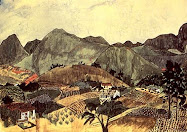
I don't know why I was so surprised at the differences in Virginia and Leonard's writing styles. It does make sense that the different experiences and travelling they had done in life might have made a big impact on said styles. In all honesty, I like Leonard's writing much more, and I have had a hard time getting into "Mrs. Dalloway". Virginia tends to let her narrative rely on social norms and customs that are local, and periodized (not to mention the writing is jumpy and slightly disconnects). Though I don't mind reading unreliable narratives, this one has just kind of rubbed at me wrong from the beginning- even though it's becoming progressively clearer.
I can easily picture many of the characters in this novel as fitting the definition of grotesque by Anderson's standards, though they seem to hide their loneliness a little better, since their misery in their social situation is sort of expected.
At this point in the novel, I can't help wanting to learn more about the characters, especially Peter, since he just came back from India, and might well be a character loosely based on Woolf's husband?
Thursday, June 25, 2009

Setting
I'm not sure how Virginia Woolf feels about setting quite yet; I haven't read enough of her book. What I can see from the assigned reading is that she approaches the form of her writing as it relates to the setting of her story in a much different way than Leonard Woolf and Sherwood Anderson.
In the opening scene on the busy streets of London, Woolf shifts perspective quickly and without warning. The narrator allows the reader to both gaze at the action in the streets and to hear the thoughts of the individuals within view. The free indirect discourse mirrors the chaos of the city street, and what seems like a random shifting of perspective may actually be something like a stream of consciousness, but one that is passed between characters with time being relative to each voice. Brandon is right to say that in Mrs. Dalloway "we have an uninhibited access to mind as setting, where mood, memory, and space all interact within the subconscious, evoking interplay between past and present, time and place." However, the interplay between these elements of "past and present, time and place" seem to be more intimate. It seems that with her sentences Woolf is demonstrating a union and inseparability between these traditionally separate elements in literature. Woolf seems to be constructing her sentences, her paragraphs, and her plot in such a way that time and space, and form and content, cannot exist separately.
The setting of the busy street is much different, then, than the scene in Clarissa's bedroom. The intimacy and quiet of the room make it possible for the reader to more clearly understand Clarissa's thoughts. The setting of her home is calm and peaceful, and so Woolf's prose is calm and peaceful. When Peter enters the room the prose shifts again and reflects the interplay between Clarissa and Peter on a verbal, and almost telepathic, level. As the discussion intensifies so does the prose, thus demonstrating that mood affects form as much as setting.
In the opening scene on the busy streets of London, Woolf shifts perspective quickly and without warning. The narrator allows the reader to both gaze at the action in the streets and to hear the thoughts of the individuals within view. The free indirect discourse mirrors the chaos of the city street, and what seems like a random shifting of perspective may actually be something like a stream of consciousness, but one that is passed between characters with time being relative to each voice. Brandon is right to say that in Mrs. Dalloway "we have an uninhibited access to mind as setting, where mood, memory, and space all interact within the subconscious, evoking interplay between past and present, time and place." However, the interplay between these elements of "past and present, time and place" seem to be more intimate. It seems that with her sentences Woolf is demonstrating a union and inseparability between these traditionally separate elements in literature. Woolf seems to be constructing her sentences, her paragraphs, and her plot in such a way that time and space, and form and content, cannot exist separately.
The setting of the busy street is much different, then, than the scene in Clarissa's bedroom. The intimacy and quiet of the room make it possible for the reader to more clearly understand Clarissa's thoughts. The setting of her home is calm and peaceful, and so Woolf's prose is calm and peaceful. When Peter enters the room the prose shifts again and reflects the interplay between Clarissa and Peter on a verbal, and almost telepathic, level. As the discussion intensifies so does the prose, thus demonstrating that mood affects form as much as setting.
Place in V. Woolf vs. L. Woolf
To me, place in Mrs. Dalloway is much more dynamic and as readers we experience the more visceral act of living, of being in the moment of place and time as the characters experience it. I really enjoy the multiple perspectives which lend to the fullness of both personal and communal experience. In Mrs. Woolf we have uninhibited access to mind as setting, where mood, memory, and physical space all interact within the sub-conscious, evoking interplay between past and present, time and place.
In The Village in the Jungle place is more fixed, more static and thus less sensational. Nature seems to elicit physical and emotional responses from the characters without the resultant glimpses into the psyche which lend such immediacy to Mrs. Dalloway. In Leonard Woolf's novel the characters' struggle for survival leaves little time for canvassing the sub-conscious, as both nature and village serve as points of congestion and discordance for the Sinhalese, leaving them with a relatively vague apprehension of their personal turmoil.
In The Village in the Jungle place is more fixed, more static and thus less sensational. Nature seems to elicit physical and emotional responses from the characters without the resultant glimpses into the psyche which lend such immediacy to Mrs. Dalloway. In Leonard Woolf's novel the characters' struggle for survival leaves little time for canvassing the sub-conscious, as both nature and village serve as points of congestion and discordance for the Sinhalese, leaving them with a relatively vague apprehension of their personal turmoil.
A Virginia Woolf/Gertrude Stein Connection
From the very beginning of Mrs. Dalloway, Woolf presents an out-of-the-ordinary approach to diction and grammatical construction. Punctuation is also askew (rampant and questionable semi-colon use) and very uncertain antecedents in many lengthy sections. As with “The Mark on the Wall,” one could describe much of it as stream-of-consciousness where the raw material of the mind spills out onto the page in the same way as happenstance thoughts flood the brain and run their course unedited. In the instances where this is pronounced in Mrs Dalloway, her writing becomes a lot like that of Gertrude Stein in her middle period. Everyone is familiar with “a rose is a rose is a rose.” Researching the time when the poem “Sacred Emily” (of which it is a part) appeared, I find that, while written in 1913, it did not appear in a book until 1922. Mrs. Dalloway appeared in 1925. Can one safely assume that Woolf read Stein? While there is enough of a plot line to contain Mrs. Dalloway’s circuitous meanderings in and out and through the thoughts of its characters, individual pages break free of any sort of narrative continuity to give an almost three-dimensional view of a scene, an object, a person. The first, and most pronounced place where this happens in the early section f the novel is where Clarissa goes to Mulberry’s (the florist.) The paragraph that begins with “There were flowers: delphiniums, sweet peas, bunches of lilac . . . .” For a full, long paragraph we wind in an out among the repeated names of flowers as if we too are looking and retracing our steps to make our selection, to experience them all—each side and center and stem, savoring each name again and again. This section certainly mirrors cubism as well (but that is another paper!)
Wednesday, June 24, 2009
The Wants of Mrs. Dalloway
It seems that Clarissa Dalloway struggles to realize what she truly wants out of life. It seems as though she has never really been sure what it is that she wanted. This is clear in the case of her husband Richard and her old friend Peter Walsh. She realizes that she compromised by marrying Richard, but is not sure that she would have been any better off marrying Peter.
Her conflicting wants can also be seen in her views of sexuality. She is aware of the lack of sexuality in her relationship with her husband. In fact, the time where she felt the most sexual was during a relationship she shared with a friend Sally Seton as a young woman. A kiss that was shared between the two of them is even described by Clarissa as being a "religious feeling" (35). However, with her reference to herself as Othello and Sally as Desdemona, is seems that she blames herself for the break in the relationship; maybe because she was re-evaluating her own feelings of sexuality and what was viewed as acceptable by those around her and by society.
Mrs. Dalloway also teeters between the want for solitude and the want for a high energy, glittering lifefstyle. She has slept alone since the time when she was ill and has continued to sleep alone because she enjoys reading in solitude. However, she also feels a need to be recognized in society and to be liked and accepted by others. For this reason, she has decided to throw the party.
These and other instances show that throughout her entire life, Mrs. Dalloway has been searching for something, although we as readers might not yet understand what that thing is.
Her conflicting wants can also be seen in her views of sexuality. She is aware of the lack of sexuality in her relationship with her husband. In fact, the time where she felt the most sexual was during a relationship she shared with a friend Sally Seton as a young woman. A kiss that was shared between the two of them is even described by Clarissa as being a "religious feeling" (35). However, with her reference to herself as Othello and Sally as Desdemona, is seems that she blames herself for the break in the relationship; maybe because she was re-evaluating her own feelings of sexuality and what was viewed as acceptable by those around her and by society.
Mrs. Dalloway also teeters between the want for solitude and the want for a high energy, glittering lifefstyle. She has slept alone since the time when she was ill and has continued to sleep alone because she enjoys reading in solitude. However, she also feels a need to be recognized in society and to be liked and accepted by others. For this reason, she has decided to throw the party.
These and other instances show that throughout her entire life, Mrs. Dalloway has been searching for something, although we as readers might not yet understand what that thing is.
Tuesday, June 23, 2009
Dr. Mary Klages summarizes Lacan's 3 stages of development (Real, Imaginary, Symbolic):
"So, to summarize. Lacan's theory starts with the idea of the Real; this is the union with the mother's body, which is a state of nature, and must be broken up in order to build culture. Once you move out of the Real, you can never get back, but you always want to. This is the first idea of an irretrievable loss or lack.
Next comes the Mirror stage, which constitutes the Imaginary. Here you grasp the idea of others, and begin to understand Otherness as a concept or a structuring principle, and thus begin to formulate a notion of "self". This "self" (as seen in the mirror) is in fact an other, but you misrecognize it as you, and call it "self." (Or, in non-theory language, you look in the mirror and say "hey, that's me." But it's not--it's just an image).
This sense of self, and its relation to others and to Other, sets you up to take up a position in the Symbolic order, in language. Such a position allows you to say "I", to be a speaking subject. "I" (and all other words) have a stable meaning because they are fixed, or anchored, by the Other/Phallus/Name-of-the-Father/Law, which is the center of the Symbolic, the center of language.
In taking up a position in the Symbolic, you enter through a gender-marked doorway; the position for girls is different than the position for boys. Boys are closer to the Phallus than girls, but no one is or has the Phallus--it's the center. Your position in the Symbolic, like the position of all other signifying elements (signifiers) is fixed by the Phallus; unlike the unconscious, the chains of signifiers in the Symbolic don't circulate and slide endlessly because the Phallus limits play.
Paradoxically--as if all this wasn't bad enough!--the Phallus and the Real are pretty similar. Both are places where things are whole, complete, full, unified, where there's no lack, or Lack. Both are places that are inaccessible to the human subject-in-language. But they are also opposite: the Real is the maternal, the ground from which we spring, the nature we have to separate from in order to have culture; the Phallus is the idea of the Father, the patriarchal order of culture, the ultimate idea of culture, the position which rules everything in the world."
"So, to summarize. Lacan's theory starts with the idea of the Real; this is the union with the mother's body, which is a state of nature, and must be broken up in order to build culture. Once you move out of the Real, you can never get back, but you always want to. This is the first idea of an irretrievable loss or lack.
Next comes the Mirror stage, which constitutes the Imaginary. Here you grasp the idea of others, and begin to understand Otherness as a concept or a structuring principle, and thus begin to formulate a notion of "self". This "self" (as seen in the mirror) is in fact an other, but you misrecognize it as you, and call it "self." (Or, in non-theory language, you look in the mirror and say "hey, that's me." But it's not--it's just an image).
This sense of self, and its relation to others and to Other, sets you up to take up a position in the Symbolic order, in language. Such a position allows you to say "I", to be a speaking subject. "I" (and all other words) have a stable meaning because they are fixed, or anchored, by the Other/Phallus/Name-of-the-Father/Law, which is the center of the Symbolic, the center of language.
In taking up a position in the Symbolic, you enter through a gender-marked doorway; the position for girls is different than the position for boys. Boys are closer to the Phallus than girls, but no one is or has the Phallus--it's the center. Your position in the Symbolic, like the position of all other signifying elements (signifiers) is fixed by the Phallus; unlike the unconscious, the chains of signifiers in the Symbolic don't circulate and slide endlessly because the Phallus limits play.
Paradoxically--as if all this wasn't bad enough!--the Phallus and the Real are pretty similar. Both are places where things are whole, complete, full, unified, where there's no lack, or Lack. Both are places that are inaccessible to the human subject-in-language. But they are also opposite: the Real is the maternal, the ground from which we spring, the nature we have to separate from in order to have culture; the Phallus is the idea of the Father, the patriarchal order of culture, the ultimate idea of culture, the position which rules everything in the world."
Woolf v. Woolf
One question to keep in mind as you read the opening pages of Mrs. Dalloway (to the point at which Mrs. D. ask Peter to remember her party as he is leaving):
How would you compare or contrast Leonard and Virginia Woolf?
You might consider concepts like self and place as you try to answer this question. Does Virginia Woolf represent place or describe places in the same way as Leonard does? Does Leonard Woolf handle the confrontation between cultures in the same way as Virginia Woolf? Is there a difference between the urban modernism and the colonial/village modernism? Do they each deal with the figure of the outsider in the same way? Do they both seem to be worried about individual identity or self-consciousness--or not?
How would you compare or contrast Leonard and Virginia Woolf?
You might consider concepts like self and place as you try to answer this question. Does Virginia Woolf represent place or describe places in the same way as Leonard does? Does Leonard Woolf handle the confrontation between cultures in the same way as Virginia Woolf? Is there a difference between the urban modernism and the colonial/village modernism? Do they each deal with the figure of the outsider in the same way? Do they both seem to be worried about individual identity or self-consciousness--or not?
Monday, June 22, 2009
Not my 'real' post--just some info
I was listening to a news story on NPR about the present day situation of the Tamil's in Sri Lanka and decided to research some history about that conflict. These excerpts I am posting are incomplete and the reporting somewhat one-sided, but I like that the demographics revealed in this 'collage' of info I'm posting coincides with what Woolf mentions in the story (in Chapter 5):
(sorry--the Word Document I pasted together will not post here once again--just gibberish. If you are interested in the material, send me an e-mail me at:
ideaimages@yahoo.com
and I will attach the document.)
(sorry--the Word Document I pasted together will not post here once again--just gibberish. If you are interested in the material, send me an e-mail me at:
ideaimages@yahoo.com
and I will attach the document.)
Subscribe to:
Posts (Atom)