I'm not sure how Virginia Woolf feels about setting quite yet; I haven't read enough of her book. What I can see from the assigned reading is that she approaches the form of her writing as it relates to the setting of her story in a much different way than Leonard Woolf and Sherwood Anderson.
In the opening scene on the busy streets of London, Woolf shifts perspective quickly and without warning. The narrator allows the reader to both gaze at the action in the streets and to hear the thoughts of the individuals within view. The free indirect discourse mirrors the chaos of the city street, and what seems like a random shifting of perspective may actually be something like a stream of consciousness, but one that is passed between characters with time being relative to each voice. Brandon is right to say that in Mrs. Dalloway "we have an uninhibited access to mind as setting, where mood, memory, and space all interact within the subconscious, evoking interplay between past and present, time and place." However, the interplay between these elements of "past and present, time and place" seem to be more intimate. It seems that with her sentences Woolf is demonstrating a union and inseparability between these traditionally separate elements in literature. Woolf seems to be constructing her sentences, her paragraphs, and her plot in such a way that time and space, and form and content, cannot exist separately.
The setting of the busy street is much different, then, than the scene in Clarissa's bedroom. The intimacy and quiet of the room make it possible for the reader to more clearly understand Clarissa's thoughts. The setting of her home is calm and peaceful, and so Woolf's prose is calm and peaceful. When Peter enters the room the prose shifts again and reflects the interplay between Clarissa and Peter on a verbal, and almost telepathic, level. As the discussion intensifies so does the prose, thus demonstrating that mood affects form as much as setting.
skip to main |
skip to sidebar
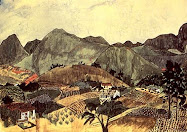
Elizabeth Bishop "Brazilian Landscape"

Pablo Picasso "Woman with a Fan" (1908)

Marc Chagall "I and the Village" 1911
A blog for ENGL 580/860 Special Studies at Wichita State University Summer 2009

Elizabeth Bishop "Brazilian Landscape"
Blog Archive
-
▼
2009
(48)
- ► 07/26 - 08/02 (4)
- ► 07/19 - 07/26 (8)
- ► 07/12 - 07/19 (6)
- ► 07/05 - 07/12 (7)
- ► 06/28 - 07/05 (1)
- ▼ 06/21 - 06/28 (8)
- ► 06/14 - 06/21 (7)
- ► 06/07 - 06/14 (7)
Class Module Three
Reading and Assignments
Anthropology and Modernism
July
7 Film: David Lean/E.M. Forster Passage to India
Paper topics discussed
9 Ruth Benedict Patterns of Culture (1934) Ch. I-IV
Blog entry-any length
14 Ruth Benedict Patterns of Culture (1934) Ch. VII and VIII and Zora Neale Hurston Their Eyes Were Watching God
(1937) Chapter 1-3
Response paper (1-2 pages)
16 Zora Neale Hurston Their Eyes Were Watching God (1937)
Blog entry-any length
Paper topic due.
Indian Modernism/Modernism and Diaspora
21 Mulk Raj Anand Untouchable (1935) to p. 100 "...clean off the map of his being."
Response paper (1-2 pages)
23 Mulk Raj Anand Untouchable (1935) and Conversations on Bloomsbury (1995)
Blog entry-any length: Comment on any blog.
28 Elizabeth Bishop and modern poetry (1935 and beyond)
North and South, Questions of Travel, and "In the Waiting Room"
860: Elizabeth Bishop in Europe by MacArthur
Blog entry-any length
30 Final Discussion
July
7 Film: David Lean/E.M. Forster Passage to India
Paper topics discussed
9 Ruth Benedict Patterns of Culture (1934) Ch. I-IV
Blog entry-any length
14 Ruth Benedict Patterns of Culture (1934) Ch. VII and VIII and Zora Neale Hurston Their Eyes Were Watching God
(1937) Chapter 1-3
Response paper (1-2 pages)
16 Zora Neale Hurston Their Eyes Were Watching God (1937)
Blog entry-any length
Paper topic due.
Indian Modernism/Modernism and Diaspora
21 Mulk Raj Anand Untouchable (1935) to p. 100 "...clean off the map of his being."
Response paper (1-2 pages)
23 Mulk Raj Anand Untouchable (1935) and Conversations on Bloomsbury (1995)
Blog entry-any length: Comment on any blog.
28 Elizabeth Bishop and modern poetry (1935 and beyond)
North and South, Questions of Travel, and "In the Waiting Room"
860: Elizabeth Bishop in Europe by MacArthur
Blog entry-any length
30 Final Discussion
Class Module Two
- Jacques Lacan hosted by U Colorado
- "The Mark on the Wall" (1921) by Virginia Woolf
- The First World War Poetry Digital Archive
- Leonard Woolf, Bloomsbury's Older Brother by Rachel Cohen THE NEW YORKER November 13, 2006
- "Aporia" in Dartmouth's Undergraduate Journal of Philosophy
- New York Times: In Venice, Peter Greenaway Takes Veronese’s Figures Out to Play
Pablo Picasso "Woman with a Fan" (1908)
Class Module One
Schedule of Readings
Preliminary Schedule of Readings
Readings are subject to change.
9 June
Introduction: Transnational Modernism?
Middle American Modernism
11 June
Sherwood Anderson Winesburg, Ohio (1919) to "Strength of God" (p. 85 in Norton)
Secondary reading required for all students: 1 review you choose
Blog entry-any length
16 June
Sherwood Anderson Winesburg, Ohio (1919) finish
Secondary reading required for all students: Kim Townsend "The Achievement of Winesburg"
Required 860 additional: John Updike "Twisted Apples"
Response paper (1-2 pages)
British Empire/British Modernism
18 June
Leonard Woolf Village in the Jungle (1913)
Blog entry-any length
23 June
Leonard Woolf Village in the Jungle (1913)
Response paper (1-2 pages)
25 June
Leonard Woolf Village in the Jungle (1913) and Virginia Woolf Mrs. Dalloway (1925) Chapter One
Blog entry-any length
30 June
Virginia Woolf Mrs. Dalloway (1925)
Response paper (1-2 pages)
Marc Chagall "I and the Village" 1911
More about Modernism...
- Perspectives in American Literature-Modernism: A Brief Introduction
- Voice of the Shuttle-Literature (in English) Modern (Brit. and Amer.)
- Modern & Contemporary American Poetry
- United States Information Agency-Modernism and Experimentation
- Architecture and Modernism by Alain de Botton
- Criticalink from University of Hawaii c.1998
No comments:
Post a Comment
Note: Only a member of this blog may post a comment.