This morning, two things happened in tandem that seemed fortuitous in this final week of "Transnational Modernism." I was reading the Bishop poems, enjoying their lovely associations and easy stretches of language while the radio, tuned to NPR, played in the background. Suddenly my ears abandoned the musicality of Bishop and tuned into the startling announcement that Merce Cunningham, the "worlds greatest choreographer" and "the last of the avant-garde" was dead at 90. I sat, stunned.
I became intrigued with Merce Cunningham years ago when I read that, as a dancer (and I must add a person) he never followed the beat--anyone's beat. He collaborated frequently with John Cage and together they questioned rhythm--they let chance dictate the flow of composition and choreography, sometimes throwing the I Ching to determine a piece. The most revelatory story I remember of Cunningham was an interview (which I still have) in the East/West Journal. He was talking about the movements of running, jumping, falling. He said how we are conditioned to see or execute those actions in that order. But he suggested the possibility of throwing a coin and having 'fall' came first--of how he would expect his dancers to execute the fall first, then maybe the jump, and finally the run. He said he always told his dancers if they met up with the impossible, they should master that then aim for at least one notch beyond it.
So this reminiscence about an artist who resides in my personal grotto of sorts got me to thinking about this class and the representative writers that we've studied--how they challenge the nature of what narrative has to be, of how they disconnect some of our assumed connections, of how they (as well as Merce) try to erase certain muscular memories so new and limitless ranges of motion can be given a chance.
I turned off the radio and returned to Bishop. I re-read "The Map." It makes its opening statement. Then the second line questions, "Shadows, or are they shallows..." and immediately after ending that question, leads to yet another possible interpretation of the view, "Or does the land lean down to lift the sea from under?" And finally, Bishop ends the first stanza with yet another angle, "Is the land tugging at the sea from under?" Her modernist view allows all possibilities at once. Formed, as they are, by a query, she does not provide us with a tidy answer. It could just as well be the three movements of running, jumping, falling. She, nor the reader, has to begin with one over the other. She could reverse the order of her questioning. I would still have to sit at the table and construct the meaning for myself.
Ruth

Subscribe to:
Post Comments (Atom)
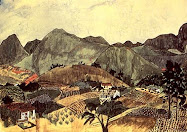


Questions, diversions, interruptions-all are constant in Bishop's repertoire. These moments of doubt, of the mind interrupting the speaker's flow of consciousness as transmitted on the page, enact the free-play of the mind as it gropes to assemble coherence, to order and classify and to question further--to explore.
ReplyDeleteI think in some ways "The Map" is much more concerned with map-making than an actual map. Think of the linguistic exercises taking place in stanza 1-the metonymy and methaphor involved in the use of "shallows" and "shadows" and again with "edges" and "ledges." According to Jeffrey Gray "The Map" [conflates] language, map, and territory with the linguistic world absorbing all the others." We see this further with the map's letters splayed across the canvas as, "the names of seashore towns run out to sea" and across mountains. This reliance on naming and shaping begs the question: Is perception possible without construction?
That would be "metaphor."
ReplyDeleteRuth, there is some commentary on "Songs For a Colored Singer" in Thomas Travisano's work Elizabeth Bishop which can be accessed on Google Books and you can access the specific content on "Songs" by searching Google Books for the poem's title.
ReplyDeleteIf you want the hard copy I beleive it is in the WSU library.